Agentic Mesh · Lifecycle
2026Agent coverage across SAP Activate
How end-to-end and phase-focused agents contribute from Discover through Run—and how their involvement adapts to each S/4HANA transformation.
ETM4S4 uses the six SAP Activate phases as its lifecycle. It does not replace SAP Activate or introduce a competing implementation method. It adds an operating model for how people and specialized agents can perform, coordinate and assure transformation work along that lifecycle.
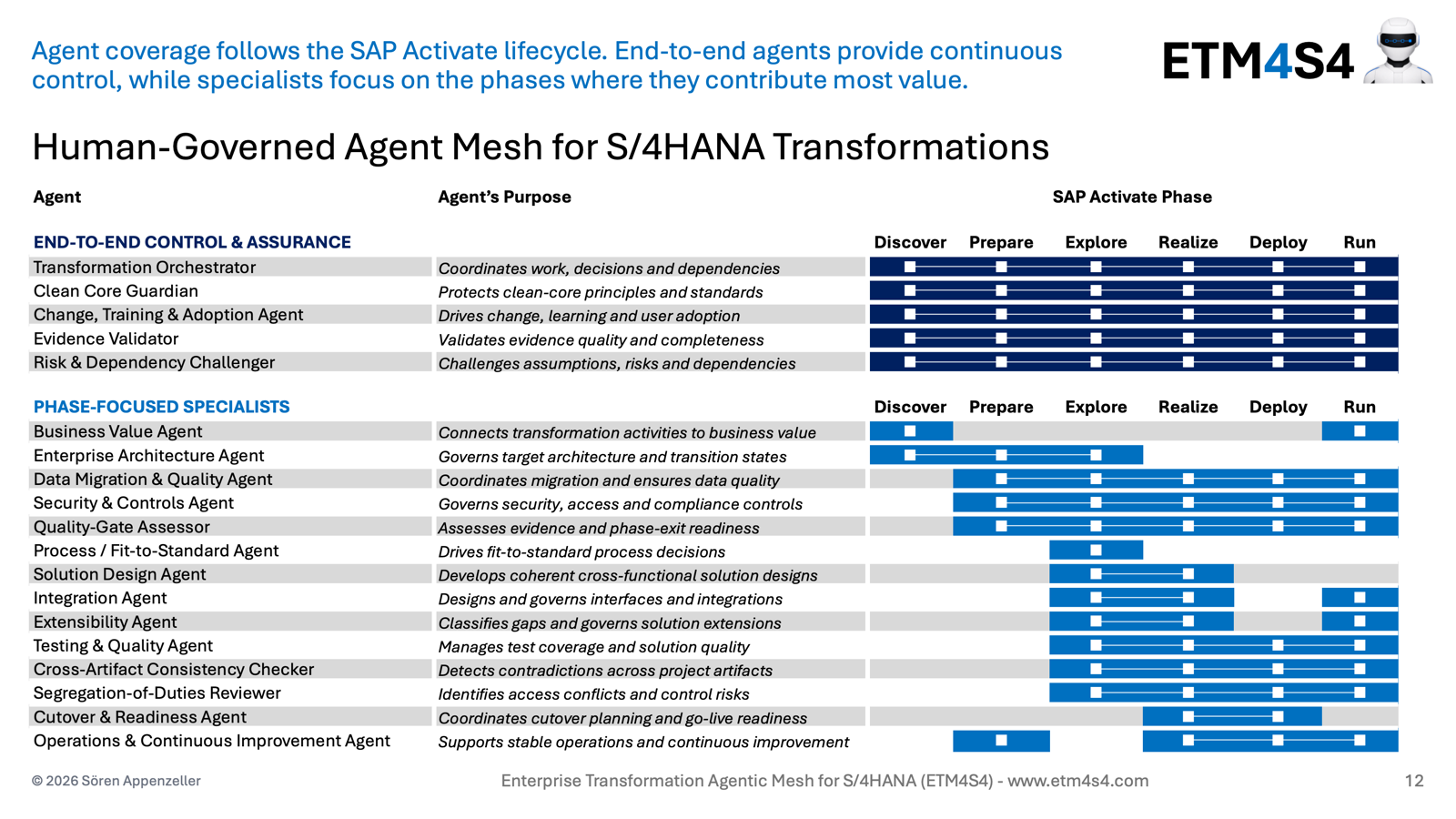
How to read the lifecycle model
The visual distinguishes between two patterns of involvement:
- End-to-end agents maintain continuity across all six phases. They coordinate the transformation, protect cross-cutting principles, support adoption and continuously challenge evidence, risks and dependencies.
- Phase-focused specialists concentrate their work where a particular capability is most important—for example, fit-to-standard during Explore or cutover coordination during Realize and Deploy.
The coverage is deliberately indicative. A highlighted phase means that the agent is expected to perform substantial work, not that it owns the phase or replaces the accountable human role. A phase without a highlighted block does not necessarily mean that the agent is disconnected. It may still receive decisions, respond to an impact request or provide specialist advice.
This distinction matters for agents such as the Business Value Agent, Enterprise Architecture Agent and Integration Agent. Their most intensive work may occur in selected phases, while important changes can require their involvement at any point.
End-to-end control and assurance
Five agents provide the continuous connective tissue of the initial mesh:
- Transformation Orchestrator: coordinates work, decisions, dependencies, evidence and human approvals.
- Clean Core Guardian: evaluates decisions against clean-core principles and routes material exceptions.
- Change, Training & Adoption Agent: maintains the connection between solution change, stakeholder impact, learning and adoption.
- Evidence Validator: checks whether important claims and readiness statements are supported by current, attributable evidence.
- Risk & Dependency Challenger: tests assumptions and identifies connected risks before they become program issues.
Continuous involvement does not mean constant activity at the same intensity. It means that these responsibilities remain active and that relevant events can trigger analysis throughout the transformation.
Discover: establish direction
Discover frames why the transformation should happen and what it should achieve. Agents can help connect:
- business outcomes and value hypotheses;
- initial process and capability scope;
- landscape and architecture implications;
- transformation and deployment options;
- major assumptions, risks and dependencies; and
- the evidence behind the investment decision.
The Business Value Agent and Enterprise Architecture Agent are particularly important here. The end-to-end agents establish continuity so that the business case, assumptions and early decisions do not disappear when implementation begins.
Prepare: establish the delivery and control environment
Prepare is more than project mobilization. For an agentic operating model, it also establishes the conditions under which agents may work:
- accountable owners and decision authorities;
- authoritative repositories and stable identifiers;
- access permissions and approved tools;
- data, privacy and security controls;
- evaluation criteria and baseline examples;
- escalation, override and incident procedures; and
- initial migration, testing, adoption and operations strategies.
The Data Migration & Quality Agent, Security & Controls Agent and Operations & Continuous Improvement Agent begin important foundation work in this phase. Assurance agents help verify that the operating model is ready before autonomy expands.
Explore: connect fit-to-standard decisions
Explore is the most design-intensive phase. Process, architecture, solution, integration, extensibility, data, security, testing and assurance capabilities converge around fit-to-standard workshops and design decisions.
The Process / Fit-to-Standard Agent can structure workshop evidence and prepare proposed outcomes. Other agents evaluate the consequences:
- Does the decision require an extension?
- Which integrations, roles, controls and data objects are affected?
- Which tests and adoption activities will be required?
- Does it remain consistent with architecture and clean-core principles?
- Which human owner must approve the decision or exception?
The value of the mesh is not that one agent answers all these questions. It is that specialized agents examine the same governed decision from different perspectives and return their findings to an accountable decision process.
Realize: maintain coherence while the solution changes
During Realize, approved decisions become configuration, extensions, integrations, migration cycles, controls, tests and learning content. Iterative delivery makes continuous impact management especially important.
Agents can maintain traceability, propose affected artifacts, detect inconsistencies and assemble evidence. For example, a revised billing requirement can trigger analysis across accounting, tax, integration, security, data, testing and training without waiting for every team to discover the change independently.
Human specialists continue to make design trade-offs, resolve ambiguity, approve exceptions and control consequential system actions.
Deploy: converge on an evidence-based production decision
Deploy brings multiple readiness dimensions together:
- cutover and rollback planning;
- final migration and reconciliation;
- security and control readiness;
- test completion and residual defects;
- business and user readiness;
- operational support and hypercare; and
- quality-gate evidence.
The Cutover & Readiness Agent coordinates the integrated view, while assurance agents challenge whether the available evidence supports the recommendation. The formal go-live decision remains with the designated human governance body.
Run: continue transformation after go-live
Run is not simply the end of implementation. The focus shifts to operational stability, adoption, benefit realization, clean-core health and continuous improvement.
Agents can correlate service, process, adoption and value signals; assess the impact of releases; identify drift; and prepare improvement proposals. The Business Value Agent reconnects operational outcomes to the original transformation case. The Operations & Continuous Improvement Agent helps turn production experience into a governed improvement backlog.
Coverage is configured, not copied
The visual is a reference model, not a fixed digital staffing plan. Actual coverage should reflect:
- greenfield implementation, system conversion or selective transition;
- SAP S/4HANA Cloud Public Edition or Private Edition;
- program scale, deployment waves and localization scope;
- industry and regulatory requirements;
- available project knowledge and tool integration;
- agent maturity and demonstrated performance; and
- the organization’s approved level of autonomy.
An organization should not deploy all nineteen agents simply because they appear in the model. It should start with a bounded value case, establish the required governance and shared knowledge, and expand coverage when the capability has earned trust.