Insight · Agentic transformation
2026From GenAI Assistance to an Agentic Mesh: A Practitioner’s View of the Next S/4HANA Transformation Model
How a human-governed mesh of nineteen specialized agents could reduce coordination cost, improve quality and shorten S/4HANA transformation timelines.
A target operating model of 19 specialized, human-governed agents across SAP Activate
After 30 years working with SAP and contributing to more than ten S/4HANA transformations, I have seen tools improve, methodologies mature and specialist capabilities deepen. Yet one problem has remained remarkably persistent: the cost of coordination.
An S/4HANA transformation brings together business processes, organizational change, enterprise architecture, solution design, integrations, extensions, data, security, controls, testing, cutover and operations. Each area has its own specialists, deliverables and deadlines. But the most consequential decisions rarely remain within one area.
A change to a billing process can affect accounting, tax, interfaces, roles, controls, master data, test coverage and training. A data-quality issue can delay testing, cutover and business readiness. An extension that appears reasonable within one workstream can create long-term clean-core and operational consequences.
The project therefore depends on people who can see across these boundaries.
Experienced senior solution architects are especially important. They connect functional and technical decisions, challenge local optimization and identify consequences that are not obvious from inside an individual workstream. Unfortunately, these architects are also scarce and expensive. On many programs, too much of their capacity is consumed by reconstructing context, attending alignment meetings, reconciling documents and following up dependencies.
That is not where their experience creates the greatest value.
Generative AI offers an opportunity to change this—but only if we look beyond faster document creation. The larger opportunity is to automate parts of the coordination layer: maintaining context, detecting impacts, connecting workstreams, checking consistency and preparing evidence.
This could reduce transformation cost, improve quality, shorten implementation time and allow experienced architects and transformation leaders to concentrate on the decisions that genuinely require their judgment.
That is the purpose behind the Enterprise Transformation Agentic Mesh for SAP S/4HANA—the model I call ETM4S4.
The outcomes that matter
I am not approaching agentic transformation as a GenAI technologist looking for another application of the technology. I am approaching it as a transformation leader interested in better delivery outcomes.
Four outcomes matter to me.
Lower transformation cost
A substantial amount of program effort is spent finding information, reconstructing decisions, reconciling artifacts, consolidating status, preparing evidence and following up dependencies.
Some of this work is unavoidable. Much of it can be made more systematic and partially automated.
The objective is not simply to reduce the time required to write a specification. It is to reduce the cumulative coordination effort across the entire transformation.
Higher quality through tighter integration
Large programs can produce individually good deliverables that do not agree with one another.
A requirement changes, but the solution design still reflects the previous version. The design changes, but the relevant test cases, controls and learning materials do not. An interface is added without updating the operational monitoring concept. A role design is finalized before its segregation-of-duties implications are understood.
Quality therefore depends on the connections between workstreams and artifacts, not only on the quality of each artifact in isolation.
Shorter implementation time
Many delays do not originate from slow execution of an individual task. They originate from late discovery:
- a dependency identified during integration testing;
- a data problem discovered during a migration rehearsal;
- a security conflict found after role design;
- a missing business decision blocking several teams;
- a clean-core concern raised after development has started; or
- a readiness gap found shortly before cutover.
If dependencies and inconsistencies become visible earlier, decision and rework cycles can be shortened.
Better use of experienced people
Senior architects, workstream leads and transformation leaders should spend their time on:
- cross-functional trade-offs;
- difficult business requirements;
- architecture decisions;
- clean-core exceptions;
- risk and readiness;
- stakeholder alignment; and
- decisions with material operational consequences.
They should spend less time locating the latest document, comparing inconsistent versions, assembling meeting context and manually informing every affected workstream.
The ambition is not to remove these roles. It is to increase their leverage.
The first stage: general-purpose GenAI assistance
Generative AI is already supporting S/4HANA programs.
Consultants can use a general-purpose assistant to:
- summarize workshop transcripts;
- draft functional specifications;
- create initial test cases;
- explain configuration concepts;
- translate project content;
- prepare presentations;
- structure meeting minutes; and
- generate first versions of communications or training material.
These capabilities can produce meaningful individual productivity gains. A strong consultant who understands the subject, provides the right context and critically reviews the result can work faster.
But the delivery model remains largely unchanged.
The user selects the source material, creates the prompt, interprets the output and transfers the result into the project’s systems of record. The next workstream performs a similar exercise with its own sources, prompts and assumptions.
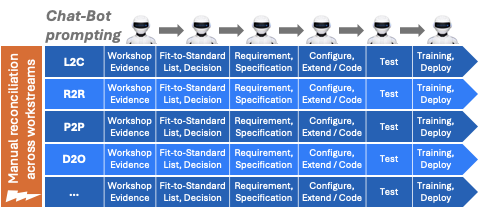
The AI makes individual activities faster, but the program still depends on people to connect them.
This creates a potential paradox: local productivity can increase while end-to-end transformation coherence deteriorates. Teams can generate and revise more content in less time, but each additional change increases the need for alignment, traceability and assurance.
Faster document creation does not necessarily create a faster transformation.
The second stage: transformation-grounded copilots
The next step is to ground AI assistance in controlled transformation knowledge.
Instead of repeatedly pasting documents into a prompt, a copilot can use approved sources such as:
- business outcomes and scope;
- process hierarchies;
- workshop outcomes;
- requirements and decisions;
- SAP Best Practices;
- architecture principles;
- solution designs;
- configuration and development standards;
- interface and data inventories;
- test results;
- control requirements; and
- project governance records.
This makes the assistance more relevant and reduces the effort required to reconstruct context for every task.
A grounded copilot can distinguish the client’s approved position from generic SAP knowledge. It can use the latest decision rather than an outdated presentation. It can show the sources supporting a recommendation.
This is an important improvement—but it is still predominantly an interaction between one user and one assistant.
The human initiates the task. The human decides which result should be shared. The human recognizes that other workstreams may be affected. The human coordinates the follow-up.
The copilot knows more, but the operating model remains human-orchestrated.
The third stage: bounded workflow agents
A workflow agent has a defined mission, a limited set of tools and an explicit degree of authority.
Consider a testing agent. When a requirement is approved or changed, it could:
- identify the processes, risks and existing tests connected to that requirement;
- propose new or revised test conditions;
- flag coverage gaps;
- route the proposal to the responsible test lead;
- record the approved result; and
- monitor whether the necessary tests have been implemented and executed.
The agent does not have to wait for somebody to formulate a new prompt. An approved change or project event can initiate its work.
This moves GenAI from content assistance into controlled workflow participation.
The boundaries are critical. The testing agent may analyze, draft and route. It should not define the organization’s risk tolerance, approve user acceptance testing or authorize a production release.
Agents can eventually execute selected actions, particularly in controlled non-production environments. But autonomy should be earned through demonstrated performance, evaluation, monitoring and effective recovery mechanisms.
The fourth stage: a governed agentic mesh
Individual workflow agents can improve specific activities. But an S/4HANA transformation is an interconnected system.
If each workstream introduces its own isolated agent, the program may reproduce its existing silos in digital form. The process agent optimizes process work. The data agent optimizes migration. The testing agent optimizes test preparation. The fundamental coordination problem remains.
An agentic mesh addresses this by connecting specialized agents through shared transformation knowledge, explicit responsibilities and governed collaboration.
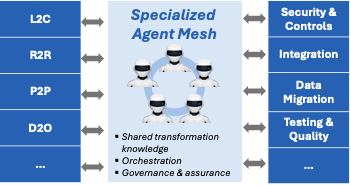
The word mesh matters.
The target is not one general-purpose assistant pretending to be a complete consulting team. Nor is it a collection of 19 independent chatbots. It is a network of specialized agents and accountable people working on the same transformation objects:
- outcomes;
- processes;
- requirements;
- decisions;
- designs;
- extensions;
- integrations;
- data objects;
- roles and controls;
- tests;
- risks;
- learning impacts;
- releases; and
- evidence.
The move from chatbot to mesh is therefore not primarily a change in AI sophistication. It is a change in the transformation operating model.
A practical example: one decision, several workstreams
Assume that an Explore workshop results in a proposed change to the billing process.
In a conventional program, the process team documents the workshop outcome and updates its backlog. Depending on the program’s operating discipline, the consequences may then be discussed in architecture meetings, dependency calls and design reviews.
Accounting, tax, integration, security, data, testing and change teams may each receive the information at different times. Some may continue working from the previous design. Experienced architects have to recognize the potential impacts, bring the right specialists together and reconcile the resulting positions.
A chatbot can create the revised requirement more quickly. But a better-written requirement does not automatically update the rest of the transformation.
In an agentic mesh, the proposed billing decision becomes a governed transformation object with a stable identity, status, owner, source evidence and connected dependencies.
Specialized agents can then examine the same decision from different perspectives:
- The Process / Fit-to-Standard Agent structures the workshop evidence and distinguishes confirmed requirements from preferences and open questions.
- The Solution Design Agent prepares the cross-functional solution implications.
- The Enterprise Architecture Agent checks alignment with the target landscape.
- The Integration Agent identifies affected interfaces, events and mappings.
- The Extensibility Agent assesses whether a genuine gap exists and which extension pattern may be appropriate.
- The Clean Core Guardian challenges the deviation and identifies standard alternatives.
- The Data Migration & Quality Agent identifies affected data objects and reconciliation requirements.
- The Security & Controls Agent derives role and control implications.
- The Testing & Quality Agent proposes changes to test coverage.
- The Change, Training & Adoption Agent identifies affected roles, learning material and stakeholder groups.
- Assurance agents check the consistency and evidence behind the resulting recommendation.
The agents do not autonomously decide how the business should operate. They make the relevant consequences visible, prepare options and route unresolved questions to the accountable owners.
Senior architects can then focus on the few issues that require cross-functional judgment instead of manually discovering and assembling every dependency.
None of these transformation activities is fundamentally new. Good programs already try to perform them. The difference is continuity, frequency and cost.
The ETM4S4 target picture: 19 agents
My current ETM4S4 reference model contains 19 specialized agents.
This is not a recommendation to deploy 19 agents on day one. It is a target architecture for making the required capabilities, boundaries, collaboration and assurance explicit.
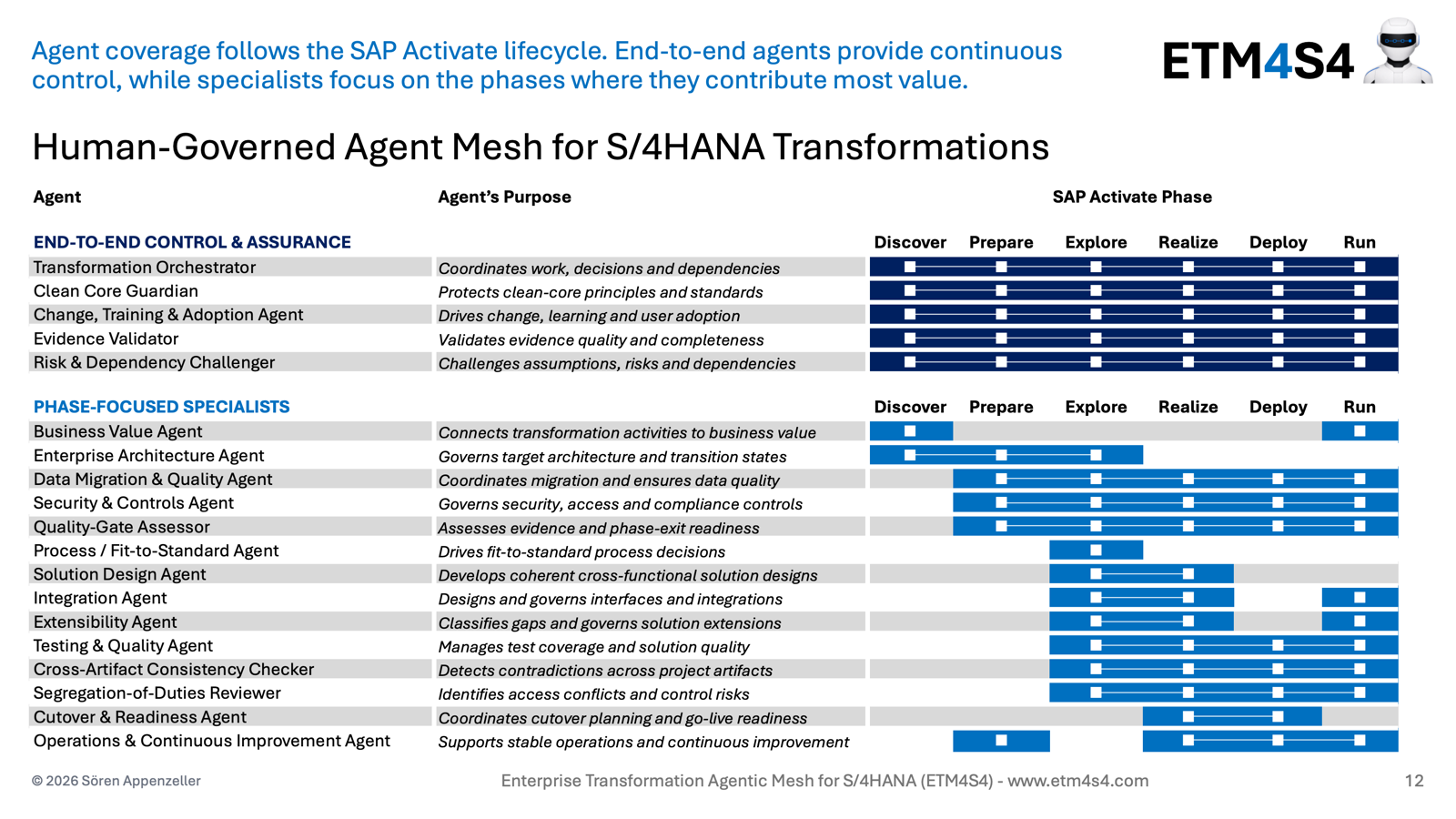
The agents are not personalities or digital job titles. They are governed transformation capabilities. Each requires a defined mission, relevant skills, approved knowledge, tool access, controls, evaluation and a named human owner.
The following catalog provides a first overview. The accompanying lifecycle graphic shows where each capability contributes across SAP Activate, while detailed agent profiles are available elsewhere on ETM4S4.
The reference mesh has three layers.
Control plane: maintain direction and coherence
1. Transformation Orchestrator
The Transformation Orchestrator maintains the integrated view of lifecycle progress, decisions, dependencies, evidence and human approvals.
It coordinates work across the mesh but does not replace the program director. It cannot change scope, accept risk or approve its own recommendations.
Its value is particularly relevant to transformation offices and senior architects. Instead of repeatedly consolidating disconnected views of the program, they receive a structured picture of what has changed, what is affected and where human intervention is required.
2. Business Value Agent
The Business Value Agent maintains the connection between transformation outcomes, business capabilities, scope, measures and realized benefits.
Business cases often become less visible once implementation begins. Scope and design decisions are then evaluated mainly through cost, schedule and technical feasibility.
This agent helps keep a practical question alive throughout the program: does the transformation still support the outcomes for which it was funded?
It does not invent benefits or approve investment decisions.
Domain agents: support transformation delivery
3. Process / Fit-to-Standard Agent
This agent structures workshop evidence, maps requirements to processes and SAP standard capabilities, distinguishes genuine gaps from preferences and maintains traceability into the backlog.
It supports experienced consultants and business owners; it does not replace stakeholder alignment or approve process deviations.
4. Enterprise Architecture Agent
The Enterprise Architecture Agent maintains baseline, target and transition views and connects S/4HANA decisions to the wider application and technology landscape.
It helps prevent locally sensible program choices from creating enterprise-level duplication, technical debt or transition risk.
5. Solution Design Agent
The Solution Design Agent coordinates cross-functional S/4HANA design.
Its role is especially important where decisions span modules and technical domains. It synthesizes approved process choices, standard capabilities, architecture principles and specialist assessments into coherent solution options.
The chief solution architect remains accountable for the material trade-offs.
6. Clean Core Guardian
The Clean Core Guardian continuously evaluates process, extensibility, integration, data and operational decisions against clean-core principles.
Custom complexity rarely arrives through one dramatic choice. It accumulates through many individually plausible exceptions. Continuous challenge is therefore more effective than a clean-core review performed after designs and developments have hardened.
The agent can assess and escalate. The design authority decides.
7. Integration Agent
The Integration Agent maintains the integration view across SAP and non-SAP applications.
It proposes standard APIs and events, checks design patterns, supports mappings and ensures that monitoring and error handling are considered before deployment.
It does not approve non-standard patterns or independently deploy production interfaces.
8. Extensibility Agent
The Extensibility Agent examines whether an identified gap actually requires an extension and, if so, which approved pattern is appropriate.
It can compare key-user, developer and side-by-side extensibility options and make lifecycle consequences visible. It should not use rapid code generation as a shortcut around fit-to-standard or clean-core governance.
9. Data Migration & Quality Agent
This agent coordinates data-object scope, ownership, profiling, cleansing, mapping, migration cycles and reconciliation evidence.
Data quality is not a late technical loading activity. It affects process validation, testing, training, cutover and operational confidence. Treating it as a continuously connected workstream reduces repeated discovery of the same problems.
10. Security & Controls Agent
The Security & Controls Agent derives security, privacy, role and control implications from process and solution decisions.
This brings control considerations into the design while choices remain open, rather than discovering conflicts after roles and processes have largely been built.
Sensitive access and control deficiencies remain subject to human approval and risk ownership.
11. Testing & Quality Agent
The Testing & Quality Agent connects test coverage to processes, requirements, decisions, risks and releases.
It can derive test conditions, identify coverage gaps, support automation, analyze defects and assemble release evidence.
The agent improves testing continuity. It does not approve user acceptance testing or authorize release.
12. Change, Training & Adoption Agent
This agent maintains the connection between solution changes and their organizational consequences.
It identifies affected roles and stakeholder groups, drafts learning and communication content and supports readiness analysis. This allows change work to develop alongside solution design rather than downstream from it.
Leadership communication and organizational readiness remain human responsibilities.
13. Cutover & Readiness Agent
The Cutover & Readiness Agent integrates technical, data, business and operational cutover activities.
It can identify schedule collisions, missing prerequisites and dependency risks, support simulations and maintain readiness and rollback evidence.
It does not make the final go-live decision or independently execute production cutover.
14. Operations & Continuous Improvement Agent
This agent connects implementation knowledge with productive operations.
It supports operational design, monitoring, release-impact assessment and continuous improvement. Instead of losing project knowledge after go-live, the organization can retain traceability between production experience and the decisions that created the solution.
Assurance agents: provide independent challenge
Automation without independent assurance can accelerate the wrong conclusion.
The agent creating an important output should not be its only reviewer. ETM4S4 therefore separates delivery capabilities from assurance capabilities.
15. Evidence Validator
The Evidence Validator asks whether an important statement is supported by current, attributable and decision-grade evidence.
A status report may claim that a workstream is ready. The validator traces that claim to approved decisions, system records, tests and accountable owners.
It identifies weak evidence. It does not decide whether the weakness is acceptable.
16. Cross-Artifact Consistency Checker
This agent identifies contradictions and broken traceability across requirements, designs, configuration, extensions, interfaces, tests, controls and learning material.
It protects the transformation from document drift, but it does not silently decide which conflicting artifact is correct.
17. Segregation-of-Duties Reviewer
The Segregation-of-Duties Reviewer continuously assesses process and role designs against approved conflict rules.
This makes it possible to address access conflicts before deployment, when design alternatives are still available.
The responsible controls owner continues to decide whether residual risk or a compensating control is acceptable.
18. Quality-Gate Assessor
The Quality-Gate Assessor evaluates gate criteria against current evidence, open exceptions, dependencies and residual risks.
It shifts quality-gate preparation away from collecting presentations and completion percentages toward a more transparent readiness assessment.
It prepares a recommendation. The accountable governance body makes the gate decision.
19. Risk & Dependency Challenger
The Risk & Dependency Challenger acts as the mesh’s constructive skeptic.
It examines assumptions and connected risks across the program. A delayed data decision, for example, may affect testing, training, cutover and benefit realization. The agent makes that chain visible before the original risk becomes several program issues.
It does not set risk appetite or own the mitigation.
How the mesh supports SAP Activate
ETM4S4 does not propose a replacement for SAP Activate.
SAP Activate remains the implementation backbone, with its six familiar phases: Discover, Prepare, Explore, Realize, Deploy and Run. The agentic mesh proposes an additional operating model for how people and specialized agents can perform, coordinate and assure work across that lifecycle.
Discover: establish direction
During Discover, agents can help connect:
- business outcomes and value hypotheses;
- initial scope and capabilities;
- architecture and landscape implications;
- transformation options;
- major assumptions and dependencies; and
- the evidence behind the investment decision.
The objective is to preserve the original value logic into implementation rather than allowing it to disappear after funding approval.
Prepare: establish the delivery and control environment
Prepare must create the conditions under which agents can operate safely and usefully:
- accountable owners and decision rights;
- authoritative repositories;
- stable identifiers for transformation objects;
- approved tools and access;
- security, data and privacy controls;
- evaluation criteria;
- escalation and override procedures; and
- initial delivery and assurance strategies.
Introducing agents without this foundation would increase speed without necessarily increasing control.
Explore: connect fit-to-standard decisions
Explore is where process, architecture, solution, integration, extensibility, data, security, testing and change perspectives converge.
The mesh can structure workshop evidence and coordinate the assessment of consequences. It can help ensure that a process decision does not remain isolated inside a workshop result or functional backlog.
This is also where experienced architects can benefit significantly. Instead of spending much of their time collecting specialist perspectives, they can receive structured assessments and concentrate on the design choices that matter.
Realize: maintain coherence while the solution changes
During Realize, approved decisions become configuration, extensions, integrations, migration cycles, controls, tests and learning content.
Iterative delivery creates continuous change. Agents can monitor traceability, identify affected artifacts, prepare updates and detect inconsistencies before they become integration defects.
Human specialists still resolve ambiguity, make design trade-offs and approve consequential actions.
Deploy: support an evidence-based production decision
Deploy brings together several dimensions of readiness:
- cutover and rollback;
- migration and reconciliation;
- test completion and defects;
- security and controls;
- user and business readiness;
- operational support; and
- hypercare.
Agents can assemble and challenge this integrated view. The formal production and go-live decisions remain with the designated human authorities.
Run: continue the transformation
Run should not represent a loss of transformation knowledge.
Agents can correlate service, process, adoption and value signals, assess the impact of releases and prepare improvement proposals. Operational experience can be connected back to the original requirements, designs and decisions.
The transformation becomes a continuing capability rather than a project that hands over a disconnected collection of documents.
Where the economic value should come from
The business case for an agentic mesh should not depend on ambitious claims that every activity will become dramatically faster.
The more credible case is based on several cumulative effects.
Reduced coordination effort
Agents can reduce effort spent on:
- searching for authoritative information;
- reconstructing decision history;
- reconciling documents;
- consolidating status;
- preparing impact assessments;
- assembling evidence; and
- following up routine dependencies.
Across a large program, these are not small activities.
Less avoidable rework
Earlier detection of conflicting designs, missing impacts and unsupported assumptions can prevent expensive corrections during integration testing, migration rehearsals or deployment.
Avoiding a limited number of major late discoveries may be more valuable than accelerating thousands of document-production tasks.
Shorter decision cycles
Agents can prepare the relevant context, affected objects, options and open questions before a decision meeting. They can route unresolved issues to named owners and monitor follow-through.
The objective is not to automate the decision. It is to remove the delay surrounding it.
Higher delivery quality
Continuous traceability, evidence validation, consistency checks and risk-based assurance can improve quality across the complete lifecycle.
Quality becomes less dependent on periodic manual reconciliation shortly before a gate.
Greater leverage from senior architects
The scarcity of experienced solution architects is a real constraint in S/4HANA transformations.
An agentic mesh will not reproduce the judgment of someone who has seen multiple programs, understands how business and technical choices interact and recognizes the early signals of a poor design decision.
But it can reduce the amount of that person’s time consumed by gathering information and coordinating routine cross-workstream alignment.
This has two effects:
- scarce expertise can cover a larger and more complex transformation more effectively; and
- architects can focus on the ambiguous, consequential decisions where their experience genuinely changes the outcome.
The goal is not fewer architects at any cost. It is less architectural capacity wasted on avoidable coordination work.
Human accountability must remain explicit
The hardest transformation decisions are rarely difficult because information is completely absent.
They are difficult because objectives conflict, consequences are uncertain and different stakeholders carry different risks.
An agent can improve the evidence and expose the trade-off. It cannot assume executive accountability for the decision.
People must retain responsibility for:
- transformation ambition and priorities;
- stakeholder alignment;
- business-process choices;
- material architecture and solution decisions;
- clean-core exceptions;
- risk acceptance;
- sensitive productive access;
- release and go-live approval; and
- organizational leadership.
Autonomy should also differ by activity. An agent may be permitted to observe, draft, recommend, route, assess or execute within a defined boundary. Those permissions should be explicit, monitored and progressively expanded only when performance has been demonstrated.
The goal is not maximum autonomy. The goal is the right division of work.
Start with one use case that matters
No organization should begin by deploying all 19 agents.
The practical starting point is one bounded use case with a visible delivery problem and a measurable outcome.
Promising candidates include:
- fit-to-standard decision traceability;
- requirement-to-test consistency;
- clean-core exception management;
- migration reconciliation;
- quality-gate evidence preparation; and
- cutover dependency analysis.
A pragmatic implementation path is:
- Select a costly coordination or quality problem.
- Define the accountable human owner and decision rights.
- Identify the authoritative knowledge and systems of record.
- Begin with observation, analysis and recommendations.
- Evaluate accuracy, time saved, defects prevented and decision-cycle improvement.
- Add controlled tool access when the agent has demonstrated sufficient performance.
- Connect a second specialist agent where cross-workstream collaboration adds measurable value.
- Expand gradually based on evidence and earned trust.
A successful pilot is not yet an enterprise agent service. Production agents also require ownership, monitoring, access control, release management, incident handling, cost management and a path to retirement.
A better transformation system
S/4HANA transformations do not need more generated content. They need a better system for maintaining context, coordinating work, challenging decisions and preserving evidence.
I see the greatest opportunity for generative AI not in replacing experienced consultants or automating executive decisions. I see it in reducing the coordination burden that prevents experienced people from applying their judgment where it matters most.
The 19-agent ETM4S4 model is my current target picture for that transformation system. It is a reference architecture, not a fixed digital staffing plan. It will need to evolve as individual capabilities are tested against real transformation situations.
The objective is practical:
- reduce transformation cost through higher automation;
- improve quality through tighter integration between workstreams;
- shorten implementation time by finding impacts and inconsistencies earlier;
- preserve knowledge from Discover through Run; and
- free scarce senior architects and transformation leaders to focus on the decisions that genuinely require experience.
This is not autonomous ERP implementation.
It is a more connected, evidence-driven and human-governed way to deliver enterprise transformation.
I am developing ETM4S4 as a practical reference model and would welcome an exchange with transformation leaders, SAP practitioners, researchers, potential partners and organizations working on similar initiatives. If you are exploring agentic delivery models for S/4HANA or other complex ERP transformations, please connect with me on LinkedIn. I would be interested to learn about your experience, challenges and ideas—and to explore where our work could complement each other.
Continue with the complete ETM4S4 concept, explore the 19-agent catalog, review agent coverage across SAP Activate or examine the supporting governance model.