Concept · Comparison
2026From isolated AI assistance to an agentic transformation system
Chatbots accelerate individual deliverables. An agentic mesh connects decisions, dependencies and assurance across the S/4HANA transformation.
Generative AI is already changing S/4HANA delivery. Consultants can turn a workshop transcript into a fit-to-standard list, a specification, configuration guidance or test cases much faster than before. This is useful—but it does not, by itself, change how the transformation is coordinated.
The larger opportunity is to move from isolated task assistance to a connected transformation system.
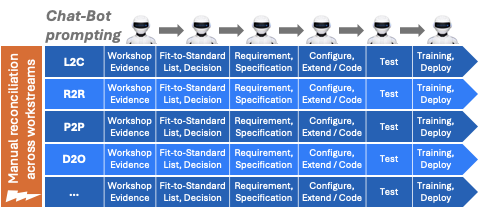
Current: isolated chatbot assistance
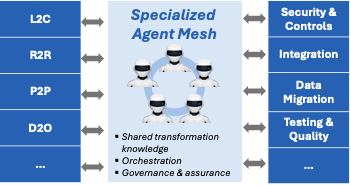
Target: a governed agentic mesh
Current reality: faster tasks, largely unchanged delivery
Most consulting use of generative AI still follows a chatbot pattern. A team provides context and asks:
- “Create a fit-to-standard list from this workshop transcript.”
- “Now draft the functional specification.”
- “Create the configuration guide and test cases.”
- “Generate development documentation or code for the approved gap.”
The resulting productivity gain is real. Summarization, drafting, translation and first-pass analysis can be significantly faster. But the user still assembles the context, formulates the request, assesses the output and transfers it into the project’s systems of record.
Different workstreams typically use different prompts, source material and interpretations. Lead-to-Cash may revise a billing requirement while Record-to-Report, security, integration, data, testing and change teams continue working from the earlier design.
The paradox is important: local productivity can increase while end-to-end transformation coherence deteriorates. More artifacts are produced and changed at higher speed, but dependency management and assurance remain manual.
The structural limitations of isolated assistance
Documents remain the primary coordination mechanism
The workshop transcript becomes a fit-to-standard list; that list informs a requirement; the requirement becomes a specification; and the specification drives configuration, extension, testing and training. Each artifact interprets the previous one. Ambiguities and assumptions can be repeated and amplified along the chain.
Context is repeatedly reconstructed
Teams copy selected documents into prompts or retrieval environments. The model may understand the immediate task, but it usually has no governed view of the complete transformation state, the authority of each source or the decisions that superseded earlier content.
Change propagation depends on people
When a design changes, project members must recognize every affected process, interface, role, data object, control, test and learning asset. The quality of this impact analysis depends heavily on experience, communication and available time.
Assurance remains periodic
Solution architects, test managers, controls specialists and quality teams reconcile artifacts before design reviews, quality gates or releases. They often spend substantial effort finding inconsistencies before they can apply professional judgment to them.
The target: connected, governed agentic delivery
An agentic mesh changes the unit of transformation work. The primary object is no longer only a generated document. It is a governed process decision, requirement, design element, control, test, risk or release—with stable identity, accountable ownership and traceable relationships.
Specialized agents can monitor those objects, use approved tools and coordinate bounded workflows. For example, when an approved Lead-to-Cash billing decision changes, the mesh can:
- identify potentially affected accounting, tax and revenue-recognition decisions;
- notify the responsible Record-to-Report, integration, security, data and testing agents;
- propose changes to connected specifications and test coverage;
- flag conflicting or outdated artifacts;
- route material decisions and exceptions to the appropriate human owners; and
- retain the evidence behind the change and its resolution.
The mesh does not assume that every connected artifact must change. It detects and explains potential impacts so that accountable specialists can validate them.
What fundamentally changes
| Dimension | Traditional delivery | Chatbot-assisted delivery | Agentic mesh |
|---|---|---|---|
| Primary optimization | Team execution | Individual task productivity | End-to-end transformation outcomes |
| Primary unit | Document and task | Prompt and generated output | Governed project object and decision |
| Context | Distributed across people and repositories | Reassembled for each interaction | Shared and maintained across the lifecycle |
| Work initiation | Human assignment | Human prompt | Human request, event or approved policy |
| Coordination | Meetings and handoffs | Human-orchestrated | Agent-assisted and policy-driven |
| Change impact | Manually analyzed | Faster analysis within a local context | Detected and routed across connected workstreams |
| Assurance | Periodic review | Faster preparation for review | Continuous consistency and evidence checks |
| Human role | Produce, reconcile and decide | Prompt, edit, reconcile and approve | Frame, challenge, decide, lead and accept risk |
| Autonomy | None | Limited to the interaction | Bounded, observable and progressively earned |
The role of experienced consultants becomes more valuable
The mesh does not remove the need for solution architects or experienced functional and technical leaders. It changes where they spend their time.
Agents can perform more continuous comparison, trace maintenance, evidence collection and dependency detection. Architects and workstream leads can concentrate on:
- cross-functional design trade-offs;
- ambiguous or novel requirements;
- clean-core exceptions;
- business and operating-model consequences;
- stakeholder alignment;
- material risk and approval decisions.
The intended shift is from manually finding every inconsistency to making better decisions about the inconsistencies and exceptions that matter.
Faster propagation requires stronger governance
Connection is not automatically beneficial. A poorly governed mesh can distribute an incorrect assumption faster than an isolated chatbot can.
That is why ETM4S4 combines shared transformation knowledge and orchestration with explicit authority, provenance, evaluation, separation of duties and independent assurance. Important changes must carry their source, status, owner and required approvals. Agents should expose uncertainty and escalate conflicts rather than silently resolve them.
The practical transition will be gradual. Most organizations will move from assistants to grounded copilots, then to bounded workflow agents and finally to coordinated multi-agent capabilities. The objective is not maximum autonomy. It is a more coherent, evidence-driven and human-governed transformation system.